
More-than-Human Temporal Ontologies Booklet
by Valentina Nisi, Marta Ferreira and Larissa Pschetz
Download Temporal Ecologies Booklet
Download sequential single pages A4
Download sequential single pages A5
Temporal representations can have a socio-political impact and change how we see the world and design technologies. The More-than-Human Temporal Ontologies booklet, promotes practical engagements with the multiple ways time can be seen as created and creating more-than-human worlds. By embodying, imagining and sketching multiple expressions of more-than-human times, and by using these to appropriate, critique and expand representations of times, we propose the final outcome of the booklet as a tool for design and researchers to structure dialogues and understanding of time and temporalities in more inclusive and expansive ways.
Development
The booklet was based on Valentina and Marta’s explorations of More than Human Temporalities that formed part of their chapter in the Designing Temporal Ecologies Book edited by Larissa. The initial concept articulated: sketching and noticing activities (part A) with more than human noticing and data annotation (part B and C) and critical reflexive reflections on more than human temporalities (part D). The initial concept materialised into a physical sketch book and was experimented with within two specific temporal ontologies. First in Ponta Gorda, secondly in Porto Santo, Madeira Islands, Portugal. Finally, Valentina, Marta and Larissa redesigned the booklet as a digital, printable version.
First Prototype
The prototype was experimented with during June and July in Madeira Island at a specific location, a coastal bathing spot, facing the Desertas Island nature reserve and seal sanctuary.
PART A – Sketch and Notice


Fig 1: Part A front of the page- Sketching and Noticing. Initial Sketching, noticing, and indexing around Club Naval do Funchal, Ponta Gorda, Madeira Island, Portugal-


Fig 2a: Part A back of the page – Sketching and Noticing. Sketching, noticing, and indexing around Club Naval do Funchal, Madeira Island, Portugal.


Fig 2b: Part A back of the page- Sketching and Noticing. After the sketching activity, further reflections surfaced during the next days and were added to the sketch
PART B- List and Focus
After the sketching, there is so much in the picture that it is hard to move on to the next, more focused phase. Similarly to observation sheets, we need some ways of scaffolding the researcher in observing something specific. The side reflections and further details makes it easier to analyse the temporal ecology. This is the intent of Part B of the booklet.


Fig 3a: Part B Front of the page- listing and focusing. After listing the More than Human (left the page), the exercises ask the researcher to focus on the choice is the Desertas Islands visible in front of the bay (Right side of the sketch page)


Fig 4: Part B 2nd page- listing and focusing. Focused Listing- After some research about the Desertas Islands, the Listing of the species currently present grows more focused and enriched of scientific information and reflections.
PART C – Traditional Representations of Time


Fig 5: PART C – Reflecting on Time encouraging reflection of traditional ways of representing time: linear, circular, spiral, parallel and future cone.
PART D – Alternative representations of time
Inspired by Elaine Gan’s More than Human Temporalities (Elaine Gan, 2021. “Diagrams: Making Multispecies Temporalities Visible”, Experimenting with Ethnography: A Companion to Analysis, Andrea Ballestero, Brit Ross Winthereik), we depart from her Diagrams to expand our conceptions of time and temporalities about our focus.
One-point Perspective:
One-point perspective is a drawing method that uses a single vanishing point on the horizon line to create the illusion of depth, where parallel lines appear to converge.
One-point perspective revolutionised painting representations techniques by adding a third dimension to the medieval 2D visualisations of space. Building on Gan’s use of one-point perspective, we apply this technique to reflecting on the island’s Temporalities.


Fig 6: PART D – Adapting One-point perspective- encouraging reflection on the Desertas island’s temporalities based on the Renaissance technique of one-point perspective. I used the island as the final converging point. Deep time progresses towards the island becoming.
Concklin’s diagrams:
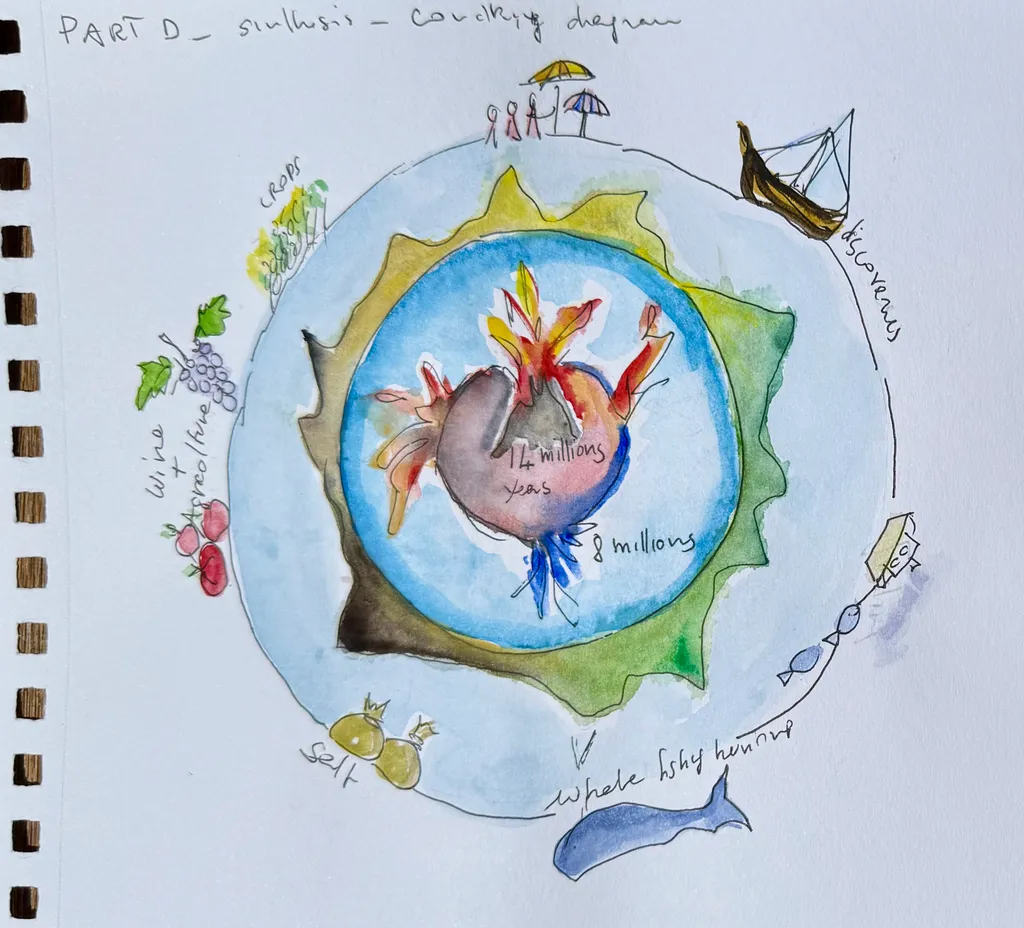
Building on Gan’s reflections on Conklin’s diagram (Ethnographic Atlas of Ifugao: A Study of Environment, Culture, and Society in Northern Luzon. Harold C. Conklin*),* I** apply it to reflect on the island’s temporalities.


Fig 7: PART D – Adapting Concklin’s Diagrams- Adapting Concklin’s diagram connecting human time with astral time (to the left side) and geological time (to the right).
Left side of Fig.7 image: from hours to days to seasons and years, to finally zoom out into astral time, where space and time are one, and stars reach us as images of their deep past. Right side of Fig.7 image: circular parallel views of time that evolve through geological eras, until the island formations.
Entangled Times and Fluid Assemblages:
Departing from Karen Barad’s notion of entanglement and Anna Tsing’s Fluid Assemblages, we use it to think and visualise the Desertas Islands Temporalities


Fig 8a: PART D – Entangled temporalities and fluid assemblages- departing from Barad’s notion of entanglement, the author experiments with visualising entangled time for the islands (left side) and geological time as a fluid assemblage (below left side). TO the right some reflections on the Booklet format- I propose more blank space and inviting questions to start the final reflective part of the exercise (PART E).


Fig 8b: Part D Entangled Temporalities and Fluid Assemblages. Focus on the Desertas Islands, represented as a Fluid Assemblage (left side of the image). The Right side of the image attempts a linear representation of the island temporalities, and some reflections on the booklet format.
PART E – Revise and Reflect


Fig 9: PART E -Revise and Reflect-
Going back to the original sketch, the author reflects and re-annotates the environmental ecology selected for the exercise, answering questions like- what do I see now? How is it different? What ethical concerns arise? The same initial sketch (fig 2a) seems now very empty- so many more processses and MtH temporaliteis are notes and reflected upon.
Post Booklet Autoethnographic reflections: After spending two days sketching the islands and researching information about their deep-time and complex temporalities, they took space inside my life. Next time I swam in Ponta Gorda, I looked up, and the islands suddenly seemed closer, bigger, brighter. I felt different in their presence. I feel closer, I am closer – I feel right there, grateful and in awe of their stunning beauty. After spending intimate and entangled time with them, I feel I am them- a part of them. Merging with their geological materiality. Have I always been?
Second Prototype
The Temporal ontologies booklet is redesigned and deployed in Post Santo Island, the Madeira Archipelago. After reflecting on and discussing the first prototype, several steps were redesigned. – This led to several changes: Part A indulges in several sketching exercises before choosing an agential cut. Part C focused on the critical unmaking of traditional time representations. Part D becomes the expansion of MtH Temporalties; Part E evolves to incorporate Fabulations to reflect and speculate on MtH temporalities.
PART A – Sketch and Notice -Sketching activity to familiarise with the surrounding temporalities and ontologies.


PART B – List and focus


PART C – UNMAKING time- Critical reflection on time representations


Autoethnographic reflections: When I engaged with UNmaking time, for UN linear time, the line traced by a wave on the sand comes to mind. It is linear but not straight, not fixed, not sequential- it progresses in waves, but it is still a line. It comes and goes, it is irregular, but it has a rhythm. It leaves things and takes them back. The foam demarks a temporary space, then it disappears in the sand. UN spiral time moves forward and backwards, as life’s emotional processes do. The direction can be reversed. Is this still a spiralling movement? UN parallel times progress in the same direction, but at a different pace; they look at each other but are never the same. Like fruits in an orchard, they grow in parallel but each one of them differently. The UN future cone, instead of generating many futures from one point, composes one specific future from many entangled elements. The depth and complexity of these critiques work towards thinking time differently (fig.14).
Reflect on temporal unmaking.
After critically working with linear, circular, spiral parallel times, future cones here are reimagined representations of time and temporalities as they might happen on the shore, involving the sea and its inhabitants, waves and currents, and the caleidoscopic and changing possibilities going back and forth between futures and pasts.


Autoethnographic reflections: I merge the critical views into one visualisation of time UNmade; the fluid seawater provides a coherent metaphor for liquid time. The UN line of the wave, UN circular tides, UN-spiralling waves, reverting, changing currents, constantly returning, always different- never the same. Even the future cone is Unmade in this liquid time – stemming from the present and past of many more than Human ecologies (of the sea) ends up focusing on a stranded piece of Sargasso seaweed. How did it arrive here? What is its future going to be like? With its past in the Caribbean waters, the future yielded a piece of seaweed stranded on a beach of the African Teutonic plate.
PART D – expansion of time representations
One-point Perspective:


Autoentnographic Refelctions: As I am engaging with the one-point perspective expansion of time, time flows and unravels as a fable, from deep astral mysterious times to majestic times of geological power and eruptions of matter. Then, biological living pass through the scene, like actors traversing a stage, huge fish and small humans – tht is how nature felt for a long time to us humans- From the bottom left corner of contemporary time/space, a looming boat, full of people, travers the sea – directed towards the lands- like castaways, looking forewad- they seem lost at sea but at the same time determined- they are all looking foreward, back in time.
Concklin’s diagrams:
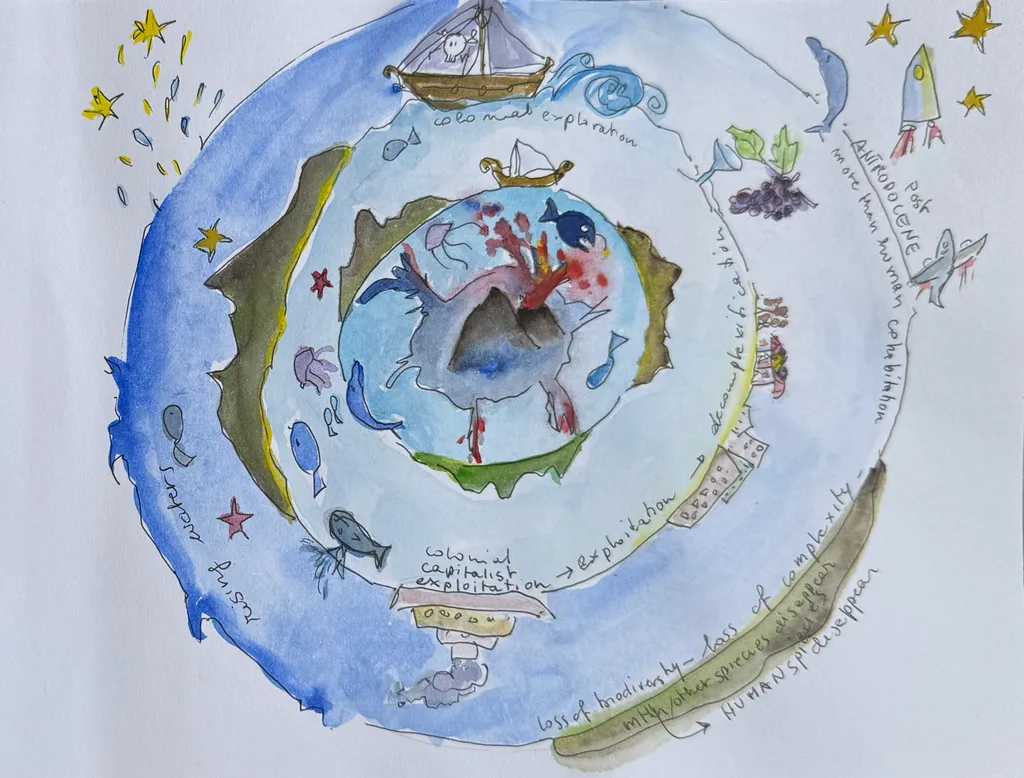
Larissa’s view of the MtH temporalities expansion diagrams generates reflection around the Anthropocene and how human taming and domination of nature are leading to a DE complexification of the surrounding ecosystem (loss of biodiversity and globalisation of culture)– if nature could reclaim the space, things might complexify again. Or are we too late? The conversation leads me to revisit the time expansion diagram (right side of fig. 16) .
Autoethnographic Reflections: I revisit the Concklin diagram, adding a layer which takes into account the planet’s reactions to the Anthropocene, and at that stage, things might start to complexify again. Men might figure out how to cohabitate respectfully with other species dealing with the effects of climate change, or the rising seas will cover all lands, and only aquatic species remain, Or raising temperatures and torrid heat killing most species on earth, and men equally disappear.
Entangled Times and Fluid Assemblages:
Autobiographical Design note: Discussing the fluid assemblages’ time representation (fig. 17), Larissa notices that the fluid assemblage’s reorientation of time as multiple coexisting temporalities spanning pasts and futures (figure 17) highlights the replication of the repeating colonial power structures over the island. From the first Portuguese explorers to the tourists’ masses invading the island today – bringing and exchanging goods and producing wealth, but for whom? And at what cost? (fig). This led to include FABULATION as a closing free-flowing speculative activity, where images Ans storytelling help us imagine affirmative futures and ethically reflect on time differently.


Autoethnographic notes: As I look at it again, the surrealistic style of the visualization acquires a deeper meaning- Colonial and post-colonial connections and entanglements that I had not surfaced yet. I realise that thinking temporalities differently could expand through fabulation.
PART E – Reflect and Fabulate
After the exercise, reflections and criticisms, it’s time to step aside, let it all simmer and sink- after some time, or maybe immediately, reflections, ideas and fabulations will evolve into concrete synthesis, discussions and inspiring new starting points for more work to do ….
**Fabulating…**Fabulating came naturally. Images surfaced, combined and took their space on the page.
Autoethnographic Reflection: Through fabulation, images surface and stories flow, connecting the images with the landscape and time representation – I can see people coming and going from the island, pirates, discoverers, and finally the flourishing tourist economy. But also, millions of years ago, erupting volcanoes. The emergence of mountains from the sea- deep time and deep-sea imaginaries- Abyssal fish that live and coexist with ancient erupting volcanoes, and today, thousands of meters deep, they are still there, living their lives in the darkness. And men – small and unaware – there … trying to survive. We infiltrate the abyss – we learn, and we fear it (last Image, part E of the second iteration of the booklet), and we admire it at the same time. We should recover these majestic images of nature- untamed, unjudgmental- part of us. The fabulation somehow surprises me- I did not know it would have taken this route- where time unfolds horizontally- parallel co-presence of different times and eras – I wonder if it will reach you, another reader, not so familiar with what this is all about? I end up reflecting on the issue of translation- do these concepts need translation or just the time to feel, and deep ways of sensing?


Fabulation 1: Fabulating with the deep captures a distant geological time (14 million years ago), when the island was still erupting. The tranquil waters and deserted landscape make it jarring to place the scene in a human timescale. Yet humans could be there- or not- in the white house on the small island in the background. The humans, if they still exist, could be survivors or have learned to cohabitate with a wild, uncompromising MtH environment.
Autobiographical commentary: On the bottom right, I am citing Alaimo (the abyss stares back), tributing Helen Bostlemann’s collaboration with Bebe and their explorations and documentation of the deep sea in the bathysphere- the wide-eyed scary look of the predator fish- the small terrified fish escaping- still beautiful in the wild and terrifying nature. On the top of the islet on the right there is a small white housr. so this scene happens during or after the anthropocene. Humans are notwhere to be seen, but their signs and artifacts are still there. Have htey just disappered? have they rarifeid ? have they been killed by the hostile post anthodpocene condtions of a majestic and harsh nature, erupting mountains and huge fish predators? are they hiding? Morale: Humans are not there, not realy needed in these lanscapes. …but still we could be there…


Fabulation 2: Here they come: as the island is still forming, we witness several incoming species, technologies and possible future /pasts. The discoverers are approaching, no way, they are pirates, …bringing sargasso seaweeds – from the carabeans? But the modern boats – full of tourists? or full of goods? Certainly, pollution is approaching as well. – and at the same time. Some new species are emerging from the Abyss, approaching the coast- have they evolved from the deep to survive the Anthropocene? Are they going to help us? Or simply ignore us, or maybe exterminate us? The tranquil tourists on the beach do not know- they are not aware- for them is just another day at the beach…
Third Prototype


We revisited the booklet to produce a digital printable version that people could download and use – several simplifications and clarifications were applied. The choice of the agential cut was positioned after the sketching activities, to let the participant familiarise themselves with the temporal ontology before choosing an agential cut. The sketching activity was combined with the noticing and annotations (parts A1 and A2 can be combined). We added a reflexive moment (A3), to let the participant pause and think about their connection with the agential cut they focused on. The process of critiquing and Unmaking time (part C) is simplified, first engaging with traditional representations of time (linear, circular, etc..) and then critiquing it. Part D– the expansion of time representations – is illustrated with examples from the previous booklets to scaffold students in bootstrapping the understanding of the Post Human concepts of alternative representations of time and temporalities. The Fabulation is not formally integrated, as it would need some extra guidance. Maybe it will emerge naturally for some, while it might be an obscure technique for others.